
Amid Rising Diesel Costs, Market Trends Fuel Opportunities for Parcel Shippers
Since about 20% of the world’s oil is shipped through the Strait of Hormuz, it was inevitable that oil prices would rise as soon as this crucial shipping lane was blocked. But few of us were prepared for the speed and scale of the price increase.
Much of the media attention around rising fuel prices has focused on consumer gas costs — but diesel fuel prices have risen even faster, as diesel reserves are generally much lower. In just the first week of the Iranian conflict, the average price of a gallon of diesel fuel rose by 84 cents, or 22%. Analysts believe that, in the next weeks, diesel fuel could exceed its all-time price record, $5.82 per gallon, reached in June 2022 after Russia invaded Ukraine.
The ripple effects of these rising costs will be enormous, impacting U.S. businesses, farms, and consumers. For Redwood’s customers, the impact could potentially be devastating for 2026 profit margins, as fuel accounts for about 25% of a shipper’s total freight spend.
As a modern 4PL, Redwood helps shippers minimize their freight costs every day, and in many ways — from switching modes to optimizing routes and consolidating shipments.
But one of the biggest cost-control levers for shippers is partnering with Redwood to manage your less-than-truckload (LTL) transportation. Even as fuel costs fluctuate, Redwood can ensure you’re always saving money over carriers’ market rates. How? While base fuel prices are beyond our control, fuel surcharges are more subjective, and can be managed strategically. And Redwood has the power to negotiate fuel surcharges with our vetted fleet of carriers, based on our overall LTL purchasing power.
Fuel Surcharges: A Major Cost Driver
Rising fuel costs get a lot of attention. But the fuel surcharges tacked on by carriers are equally important for shippers pursuing healthy profits. These often-overlooked fees can decimate margins if they’re not understood and addressed strategically.
Fuel surcharges originated during the oil crisis of the 1970s, but they’ve remained in effect since then. Instead of constantly adjusting their base rates to reflect daily diesel price volatility, carriers add percentage-based surcharges to every shipment. These surcharges are a flexible pricing mechanism that’s directly tied to external fuel cost indexes.
Because fuel surcharges are a percentage-based add-on that’s compounded across multiple line items — including accessorial fees — their bottom-line cost impact is often larger than shippers realize. For high-volume LTL shippers, fuel surcharges are a central driver of profitability.
Carrier fuel surcharges on LTL shipments originate from a weekly tracking post by the U.S. Department of Energy Information Administration (EIA), a subagency of the U.S. Department of Energy. When the EIA updates its weekly data, each LTL carrier in turn uses its own in-house fuel surcharge table to apply the right percentage-based surcharge to each shipment. All shipments tendered in that week are subject to that same calculation.
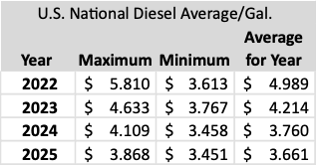 One big challenge for shippers is that the EIA’s national average rates can change suddenly and greatly. Some years are characterized by extreme price volatility, making it hard for shippers to budget, forecast, and assign loads profitably. For example, in 2022 average U.S. diesel fuel prices ranged from a low of $3.613 to a high of $5.810. For the three years after 2022, the national average was much steadier, but 2026 is beginning with the same volatility we saw in 2022.
Again, it’s not just base transportation rates that increase wildly in times of price fluctuation. Carrier surcharges rise steeply at the same time, based on these diesel costs. And shippers negotiating with carriers on their own have very little control over these surcharges.
Redwood: Proven to Cut Surcharges in Half
 That’s where the power of Redwood comes in. As a leading North American freight broker, Redwood has its own fuel surcharge table that’s negotiated with our network of carriers, based on our large customer volumes and LTL buying leverage.
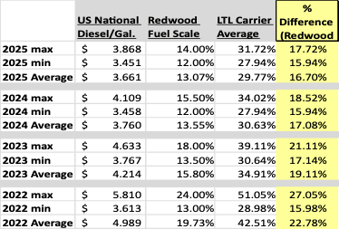
Redwood’s fuel table changes less frequently, and it’s calculated at a much lower percentage than carrier tables. Looking at 2022, at one point shippers were paying a staggering 51.05% fuel surcharge — while Redwood LTL customers were only paying a 24.0% surcharge.
Even in more stable years like 2023, 2024, and 2025, Redwood’s fuel scale is proven to cut carrier surcharges in half. Last year, some shippers paid a fuel surcharge as high as 31.72%, while Redwood customer surcharges were capped at 14%.
Hundreds of customers have saved on transportation costs and increased their margins by partnering with Redwood on LTL shipping. The results are clear.
What Are You Waiting For?
2026 already looks like a year of extreme volatility in fuel costs. That means this is your chance to take back some control over fuel surcharges before it’s too late. If margins are eroded for weeks or months, it’s hard to end the year profitably.
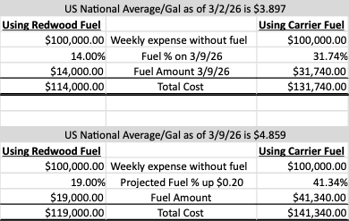 Consider this: In just the first two weeks of March, you could have saved $40,000 in carrier surcharges by capitalizing on Redwood’s fuel surcharge agreements with our carrier fleet.
As you’re reading this blog post, diesel fuel prices are still rising. Boost your margins and seize leverage by reaching out to Redwood today.