
As Diesel Prices Reach a Record, Redwood Fuels a Smart Response
FedEx Delivers Yet Another 5.9% General Rate Increase
Last week, FedEx announced a general rate increase (GRI) of 5.9%, with new fee schedules beginning to take effect on January 4, 2027. If 5.9% sounds familiar, it’s the same annual GRI announced by FedEx for 2024, 2025, and 2026. The annual increase follows the carrier’s July announcement of demand surcharges for the upcoming peak shipping season — which take effect starting as early as September 28.
In addition to the 5.9% average GRI for U.S. package shipping services, here are some key takeaways from the announcement:
- FedEx increased the 1–5 pound weight break for ground services by nearly 6.5% — the largest increase for any weight class — moving away from its practice of placing the highest increases on heavier-weight packages.
- On January 4, rates will also increase for Ground Economy, Ground Multiweight, International Premium and International Priority DirectDistribution. FedEx has not yet defined specific rate increases for those services.
- The 2027 increase to top accessorials such as Large Package, Additional Handling, and Residential Surcharge are in the 6% – 7% range.
On January 18, new administrative fees will also take effect. These include a $25 paper document fee for any shipment where an associated trade document is provided in a non-electronic format, requiring manual processing by FedEx. A paper air waybill fee of $5 per shipment will be applied to all U.S. domestic and export FedEx shipments initiated with paper airbills.
A Residential Delivery Charge will be applied to qualifying international package and express freight shipments to select destination countries, and all qualifying international shipments to the U.S. and Canada will be subject to the Residential Delivery Charge. A list of destination countries will be available from FedEx at a later date.
What’s behind the new charges?
In its 2026 Annual Report, FedEx cited a number of operational challenges. These include general economic conditions such as inflation, tariffs that are reducing overall shipping volumes, the price and availability of diesel and jet fuel, and growing competition.
These challenges may help explain why FedEx is raising rates — and it makes sense that paper processing adds labor and costs.
But consider the fact that FedEx continues to announce GRIs of 5.9%, despite very different economic conditions year-by-year. When the carrier announced its 5.9% GRI last year, inflation was at 2.9%, and today it’s around 3.4%. This suggests that FedEx isn’t merely passing costs through to shippers, but strategically targeting a certain financial yield.
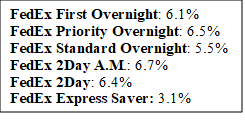
The granular details of the 2027 rate tables bear this out. Five of the carrier’s seven major services are increasing above the 5.9% average, while Express Saver is only increasing by 3.09%. And, while the average increase for Ground and Home Delivery is 6.5%, in Zones 2 – 8 the increase is 6.1%.
Clearly FedEx is competing harder in certain service segments and geographies, while it’s more confident of its position in other segments.
How can you master the new rate tables?
FedEx obviously is digging deep into its data to help define a profitable market strategy for 2027. It’s shaping demand for certain regions and services, while capitalizing on its leadership in others.
The good news? You have your own shipping data. You know your typical parcel sizes, weights, destinations, delivery timelines, and volumes. You know what FedEx services you use most often. You know exactly what you’re paying FedEx — and you have rate schedules from other carriers.
That data gives you power. Just as FedEx conducts detailed analysis, so can you. Based on that number-crunching, maybe FedEx simply isn’t the best fit for your business. Or maybe you should start using FedEx more selectively, supplementing the big carriers with smaller regional providers who might be more willing to compete for your business.
If you don’t have all this data in one place, you lack the required analytical tools, or you simply don’t have the staff, Redwood’s Parcel Advisory team can help. By providing business and financial analysis, contract negotiation coaching, execution support, and other services, Redwood saves shippers an average of 16% on their annual parcel spend.
FedEx is smart, and it’s powerful. But it’s not the only carrier option. And FedEx needs your business. By increasing your intelligence and flexing your own muscle, you can counter every FedEx rate increase with a move of your own. Contact Redwood today and let’s start shaping a more profitable 2027 for your business.